COMPASS ID · Insights

Field notes from the evidence

What COMPASS is, why we built it, and what its first atlases show about the shape of research, and the gaps in it.

Featured

Research

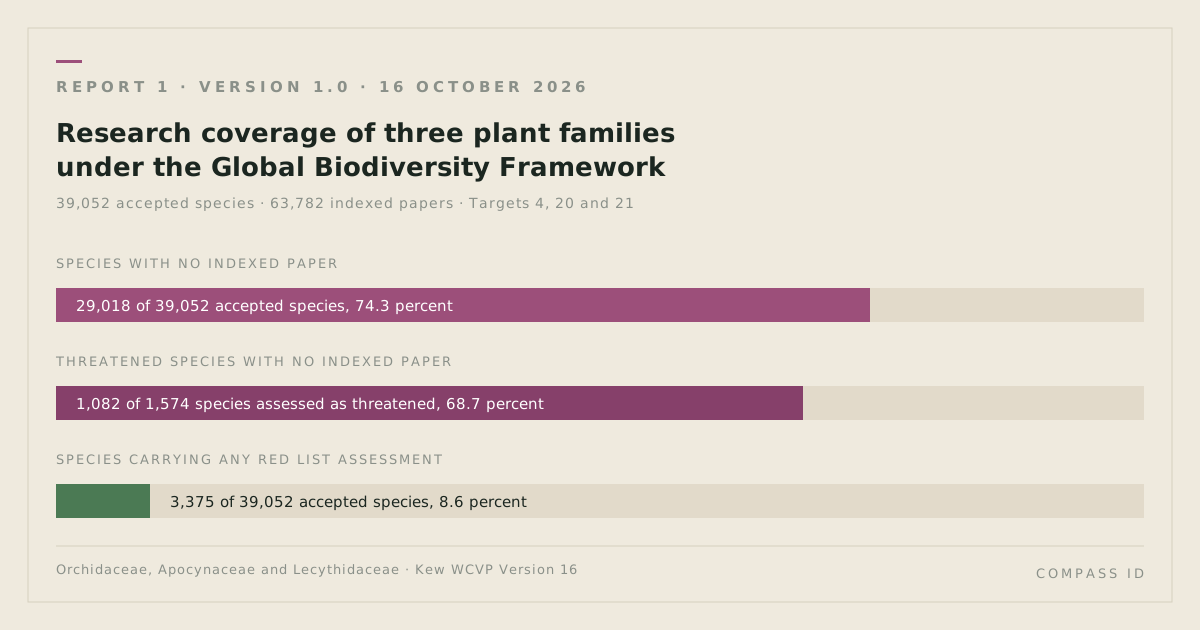
Research coverage of three plant families, measured against the Global Biodiversity Framework

Report 1 of the series Research coverage of the world’s vascular plants, 2026 to 2030, is published for CBD COP17. Of 39,052 accepted species of Orchidaceae, Apocynaceae and Lecythidaceae, 29,018 (74.3 percent) have no indexed paper, and 14 of 63,782 papers name an instrument of the Convention.

Research

Indexed research on the coffee family, species by species

The Rubiaceae research atlas reads 41,317 indexed studies of the coffee family against Kew’s checklist of 14,400 accepted species. Three quarters of the family has no indexed paper, the genus Coffea holds 34.6 percent of the research, and 74 of the 134 accepted Coffea species have none.

Research

Indexed research on the 45 wild cat species

The Felidae research atlas reads 18,019 indexed studies of the cat family against the Mammal Diversity Database checklist of 45 accepted species. Every species has a literature, five of them hold 49.1 percent of it, and 1,047 links were found only by searching a common name.

Research

Indexed research on the orchid family, species by species

The Orchidaceae evidence atlas reads 26,501 indexed studies of the orchid family against Kew’s checklist of 31,892 accepted species. Six genera that are grown, eaten or sold carry 40.6 percent of the research; 24,503 species, 76.8 percent of the family, have no indexed paper.

Research

How spatial intelligence and tagging show where research is missing

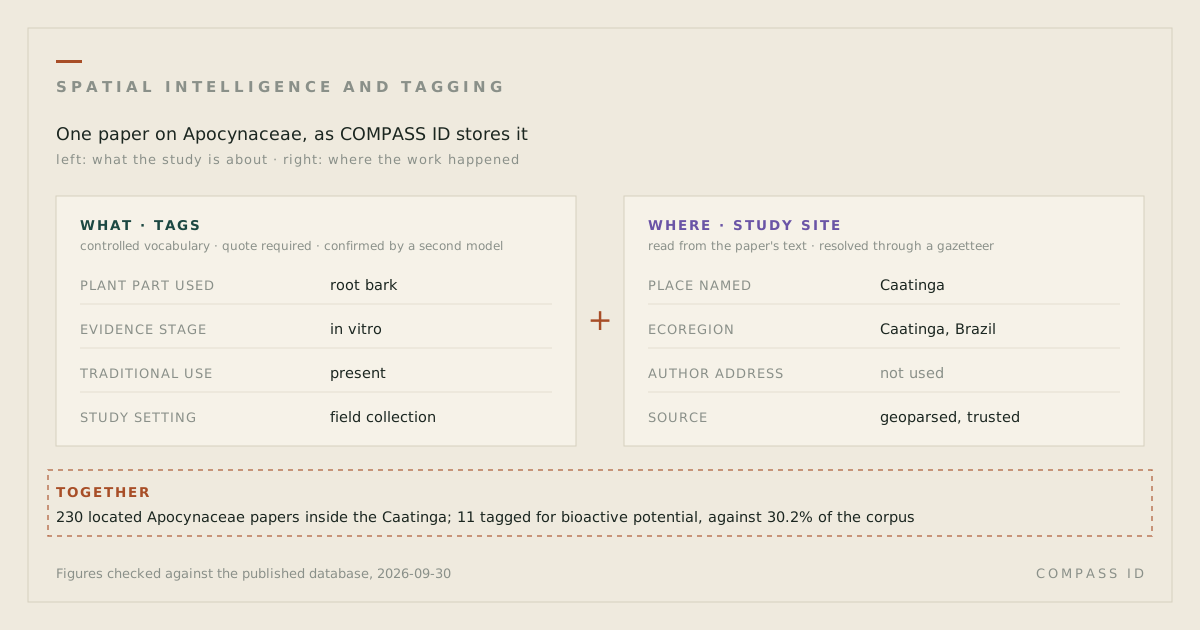
Spatial intelligence, a machine reasoning about where things are, gives every paper the study site the record never had. Joined with the tags, it shows that 1,185 of 6,753 Apocynaceae species with known range countries have a located study inside one, that 45.2 percent of Antarctic study sites lie within 100 km of a research station, and that the ecoregion with the most located research on the family carries almost none of its chemistry.

Research

What we miss when we don’t ask where

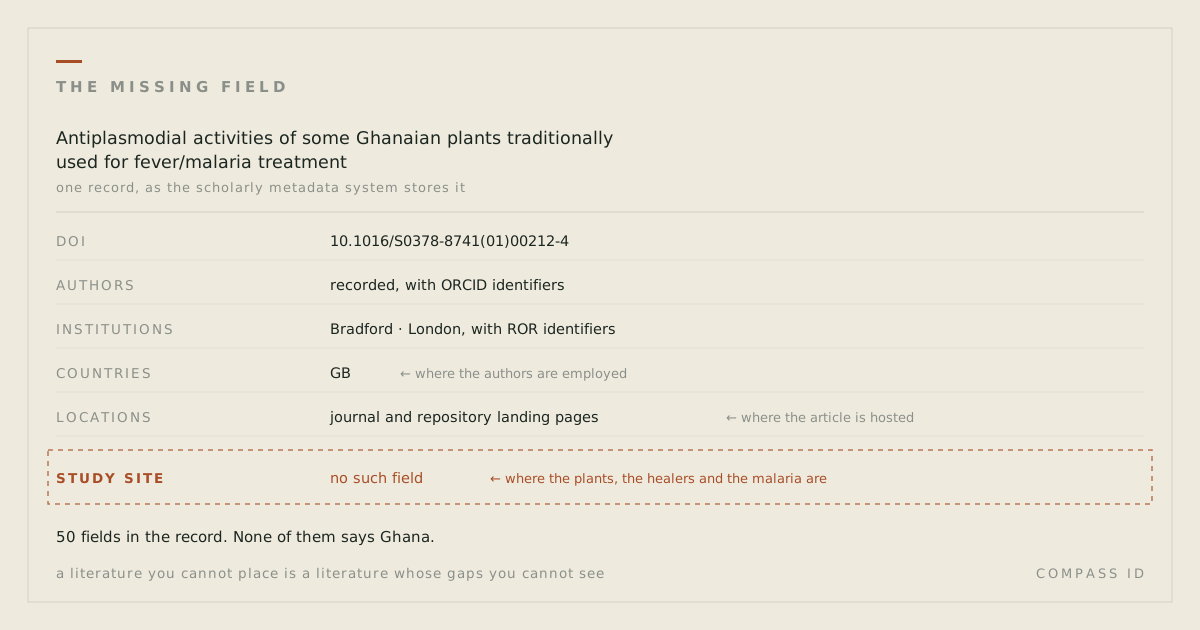
The scholarly metadata system has no field for the place a study studied. We checked all 50 fields of the OpenAlex record: every geographic one describes the authors’ employers or the journal’s website. What that hides, across the Earth, the body and the genome.

Research

What AI accuracy hides

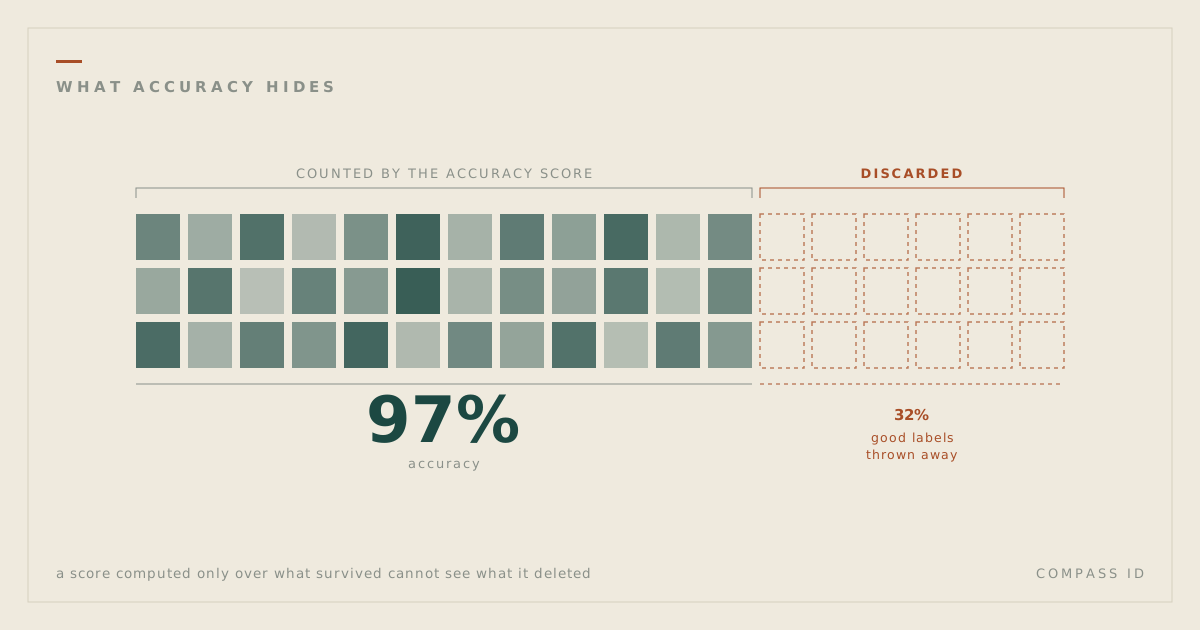
Our AI labelling pipeline scored 84–93% correct while discarding roughly half the labels it should have produced. Four measured findings on why an accuracy score cannot see that, ending with an answer key that, across five subject areas, could not defend half its own corrections.

Research

Desertification research locations compared with land degradation

Our desertification evidence atlas reads 28,111 peer-reviewed studies on desertification, land degradation and drought end to end, and finds research effort almost entirely uncorrelated with where degradation is worst, while human dimensions and rangelands remain the least-covered parts of the record.

Research

What we miss when a species has no indexed research

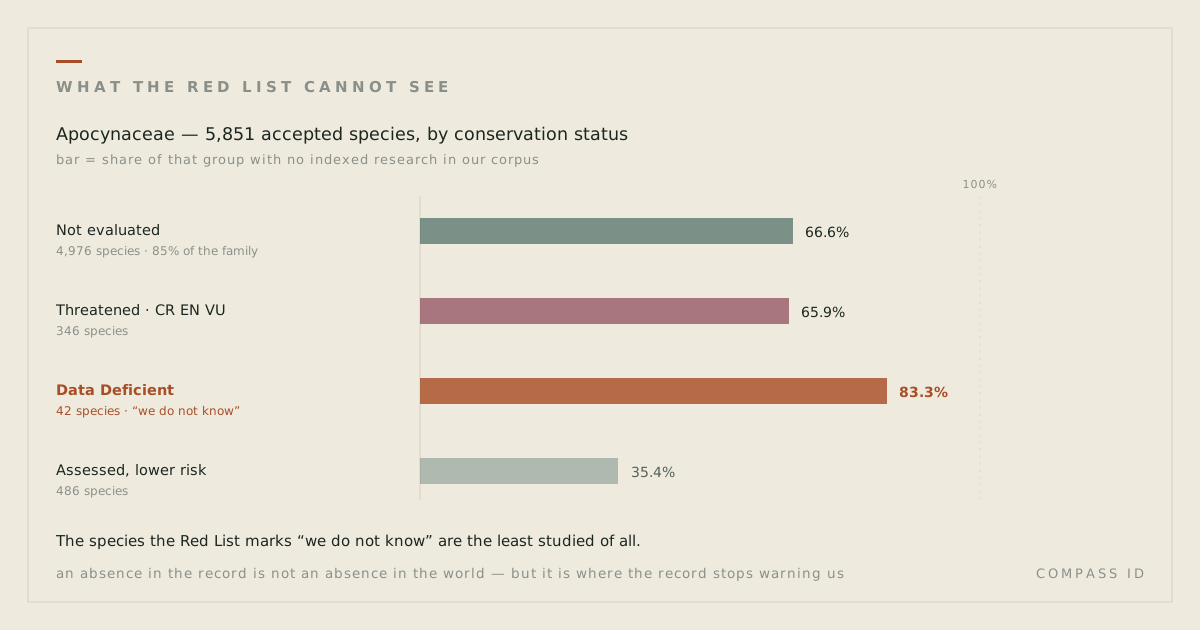
Dark extinction, the loss of species nobody ever named, cannot be counted directly. The antechamber can: species we named and then never looked at again. In Apocynaceae, the species the Red List marks “Data Deficient” are the least researched of all, at 83.3%.

Research

Indexed research on the Apocynaceae, species by species

Our first family-scale evidence atlas reads the entire dogbane & milkweed family end to end, and finds drug-discovery research concentrated on a handful of species, while 64.1% of species have no indexed research at all.

All posts

The Basics

Using COMPASS ID for scientific discovery

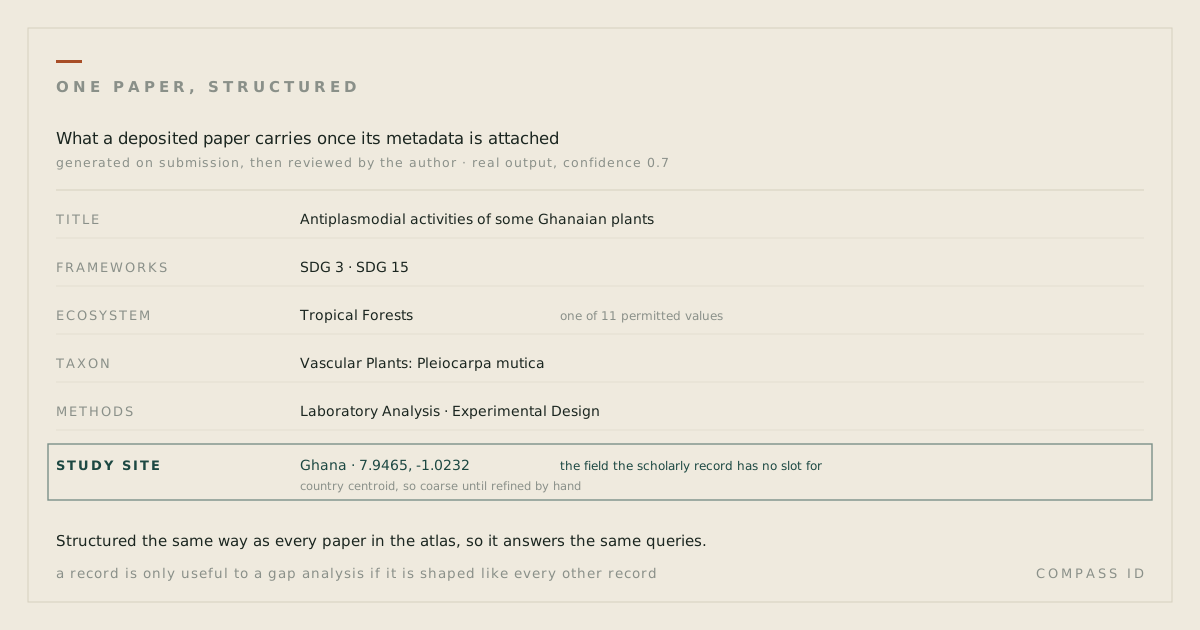
What a researcher actually does here: deposit a paper, have its metadata generated and then review it, and read the atlases for what nobody has covered. Walked end to end on the live system, with the real output shown.

The Basics

Combining research atlases with Earth observation data using natural language

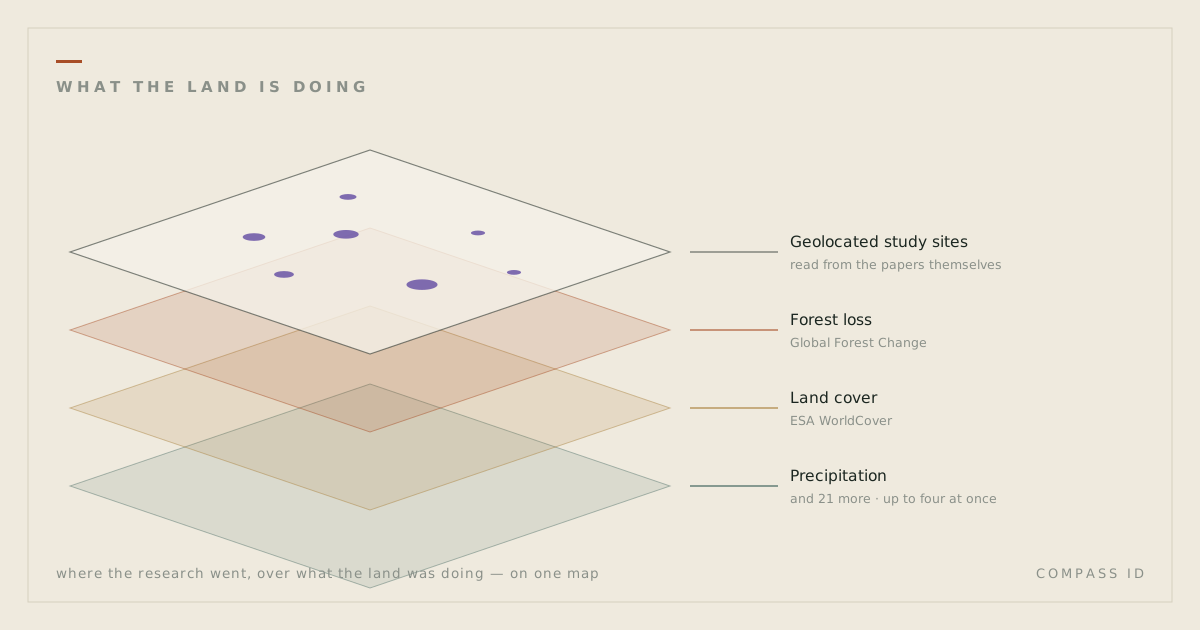
24 Earth observation datasets drawn beneath the geolocated study sites. A plain-language request is resolved into paper filters plus a layer selection; location is the only attribute the two datasets share, so location is what the join is made on. The model selects the view and does not interpret the imagery.

The Basics

How to find a research gap

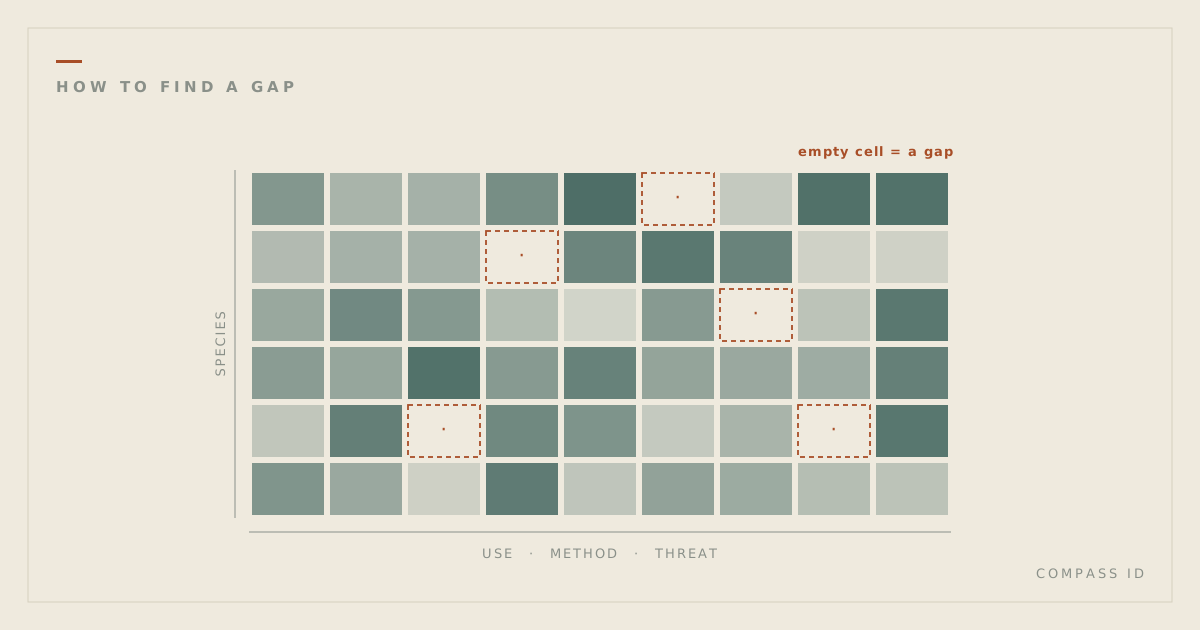
A gap in COMPASS is not "something no one has done". It is a specific, countable absence. Here is how to find one.

The Basics

How to use COMPASS ID

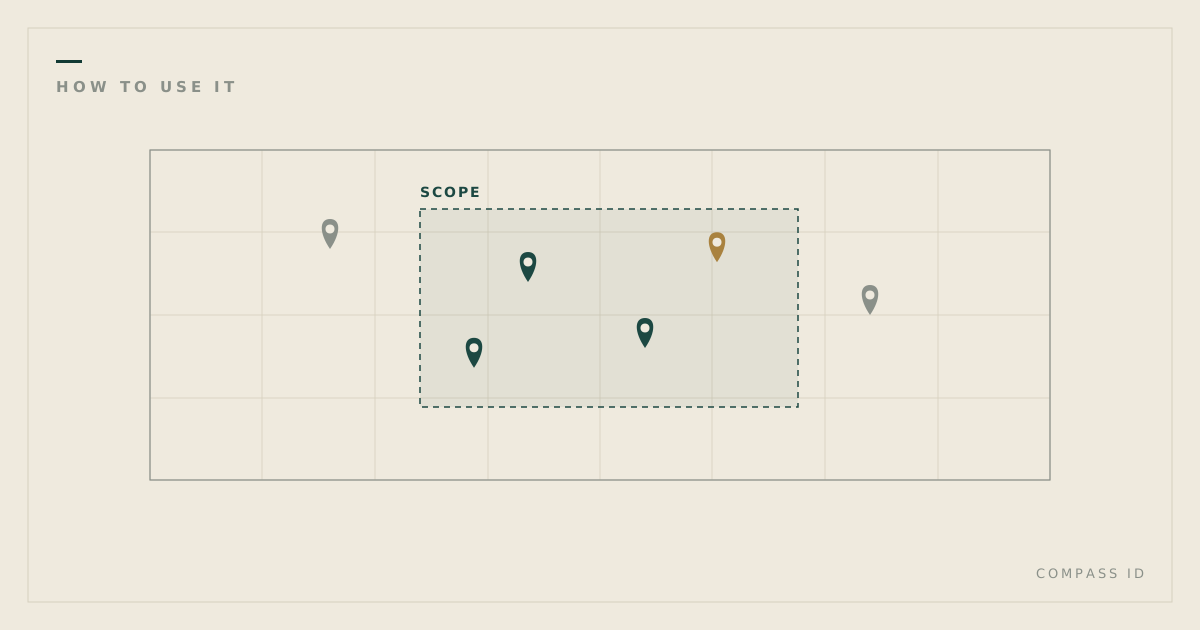
Point COMPASS at a family, a region, or a theme, and it harvests the literature, AI-tags every study, geolocates the fieldwork, and hands you an interactive evidence atlas.

Vision

Why we built COMPASS ID

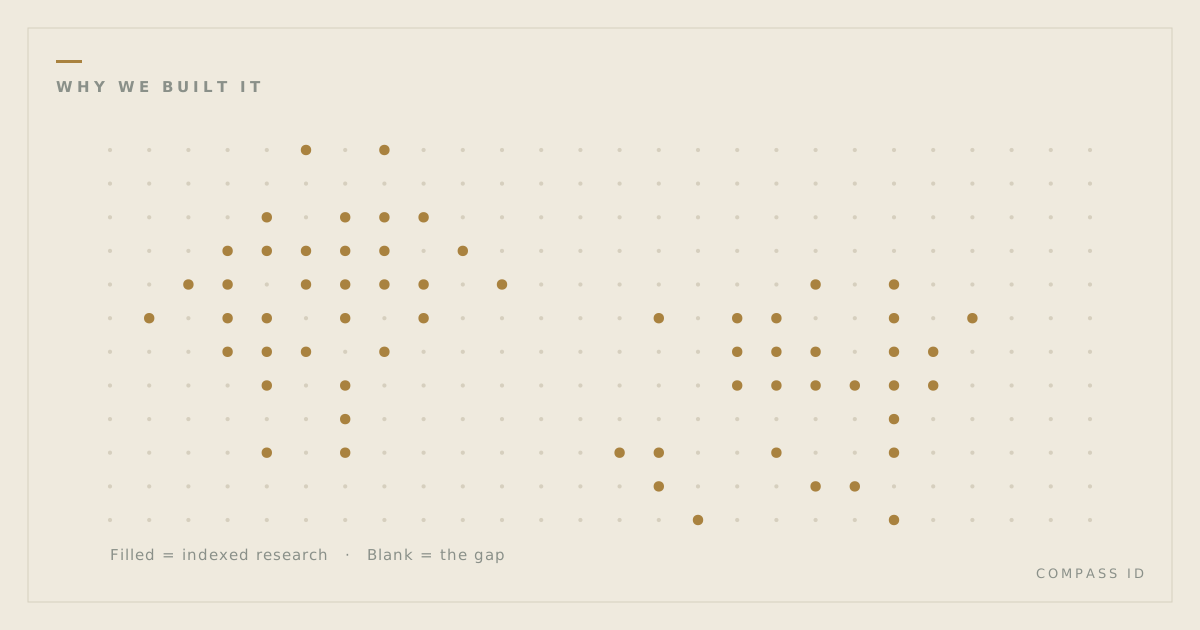
The world's research is searchable by keyword, but not by what it covers or leaves uncovered. We built COMPASS to make the shape of knowledge, and its blank spaces, measurable.

The Basics

What is COMPASS ID?

COMPASS reads an entire field of research, tags every study across dozens of dimensions, and maps what the science covers, and the vast gaps it has left dark.