Indexed research on the 45 wild cat species
The Felidae research atlas reads 18,019 indexed studies of the cat family against the Mammal Diversity Database checklist of 45 accepted species. Every species has a literature, and five of them hold 49.1 percent of it.

What the atlas is
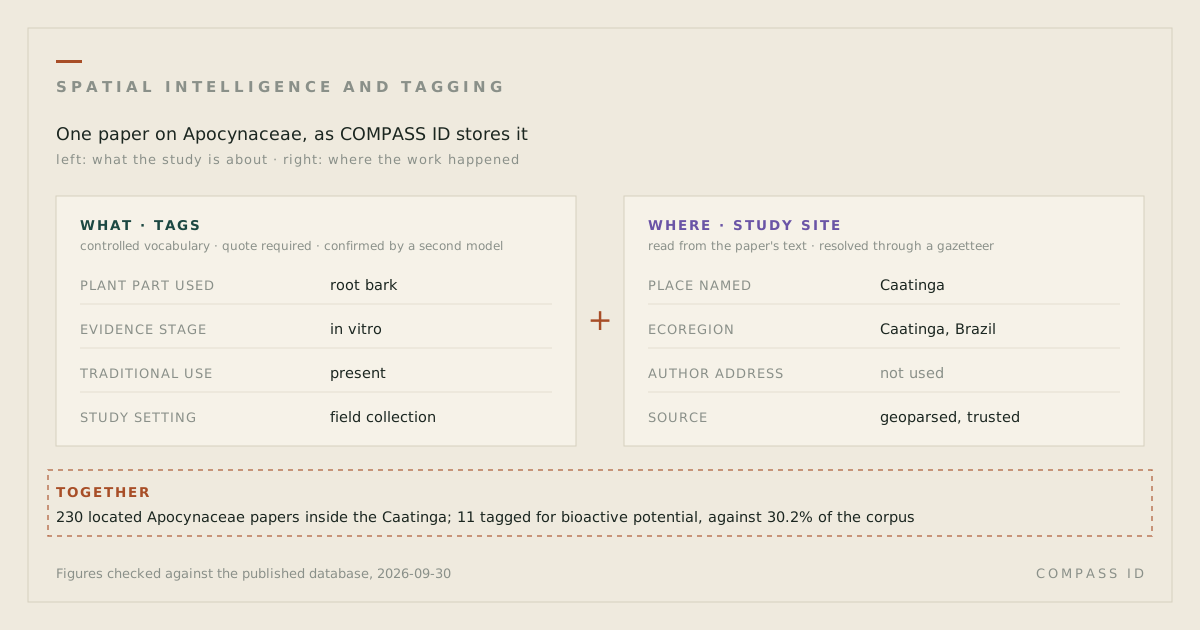
The Felidae research atlas starts from a census rather than from a search. Every accepted cat species in Version 2.5 of the Mammal Diversity Database is loaded, each is linked to the indexed literature under its scientific name and the names the checklist treats as its synonyms, every study is tagged against a 51-dimension codebook by a panel of domain-expert models with a second model checking each tag, and every study that names a field site is placed at that site rather than at its authors’ address. The result is a map of what has been studied, where, and how unevenly.
What the corpus shows
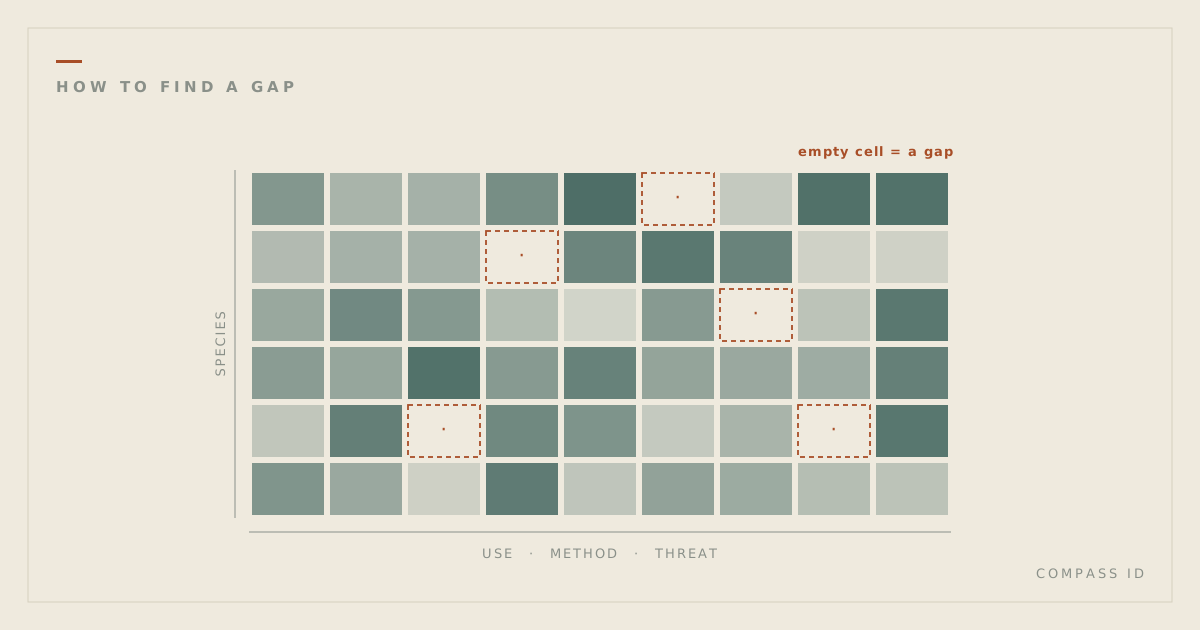
The first thing to say is a negative result. Unlike every plant family in this series, the cats have no unstudied species: all 45 have a literature. The question the atlas answers is therefore not which species are missing from the record but how the record is spread across them, and the answer is that it is spread very unevenly.
Five species carry 8,853 of the 18,019 studies, 49.1 percent of the family’s whole indexed record. They are the puma, the lion, the tiger, the leopard and the jaguar. Puma concolor alone carries 2,448 studies, 13.6 percent of the corpus, more than the 29 least studied species combined, and the genus Panthera accounts for 7,454 studies, 41.4 percent. At the other end, the six species described or split from others since 2020 hold 75 studies between them.
Threat category does not redirect the research. Thirty-eight of the 45 species carry a Red List category in the reference extract used here, 18 of them as threatened. The median Least Concern cat carries 398 studies; the median Endangered cat carries 59.5. The four Endangered species run from Panthera tigris with 2,115 studies to Catopuma badia, the bay cat of Borneo, with 32. What predicts the size of a species’ literature is body size, range size and proximity to people, not how close it is to extinction.
Of the 18,019 studies, 8,898 (49.4 percent) name a study site that the geoparser could place, across 149 countries. That is the highest located share of any corpus in this series, and it reflects a field literature rather than a laboratory one. The United States leads with 1,443 located studies, then Brazil with 775 and India with 592.
What a common-name search adds
A harvest built on scientific names is close to complete for plants, because botanical papers name their species in Latin. For mammals it is not. A large part of the applied and regional literature on cats writes only the English common name, so a scientific-name harvest silently under-counts exactly the field and management studies a conservation reader wants.
We measured that gap before closing it. A probe searched the checklist and Red List common name of each species, kept whole-word matches, checked which were already in the corpus and asked an independent model whether each unmatched paper was about the species. It put the paper-weighted recall of the scientific-name harvest at 95.1 percent, with an interval of 91.7 to 97.7, and that is an upper bound for the best-known cats because the search interface returned a capped sample size rather than a true hit count for 23 of the 55 names.
The harvest then ran over the 41 names not dominated by a homonym, judged 2,220 candidate papers one at a time and confirmed 1,116. The corpus now carries 1,047 such links on 1,039 studies. For the Iberian lynx the difference is large: 145 of its 492 studies, 29.5 percent, were found only under “Iberian Lynx”. For the jungle cat it is 26.5 percent, for the clouded leopard 25.4 percent. Three names, Jaguar, Bobcat and Snow Leopard, exceeded the per-name limit set for this pass and were deferred, and eight names whose word has other dominant meanings, among them Lion, Tiger and Puma, were excluded. Those eleven are a stated gap in this version.
How the figures were checked
Whole-corpus tag precision was measured by a third model that is never used as tagger or judge, shown the paper, the dimension, the stored evidence span and the codebook rubric, and asked to confirm or reject without being told the tag had already been confirmed. It confirmed 158 of 199 sampled tags, 79.4 percent, with a 95 percent interval of 73.2 to 84.4. The 6,317 studies added by a name-by-name re-harvest were re-judged separately at 76.5 percent, 153 of 200; that sample includes 806 title-only records, which is why it sits lower. The June 2026 corpus, tagged under the previous codebook, measured 75.5 percent on the same design.
Link precision was measured by an adversarial role judge on 233 sampled links from 47 entities: 81 percent are papers that study the species, 42 of 233 name it without studying it and 2 are unrelated. The share that merely names a species is higher here than in the plant atlases, because the big cats are routinely cited as example or flagship species in papers about something else.
One limitation is worth naming. The known-range country list for the cats comes from GBIF occurrence records of every basis, so a zoo, a museum skin or an escaped animal puts a species in a country it does not inhabit. The range comparisons in the atlas carry that caveat, and a native-range source is the clearest improvement available to the next version.
How to use it
The atlas is organised as sections that each answer one question. Section 02 gives the concentration of the record on five species. Section 03 sets research effort against Red List category. Section 04 is the common-name step and its per-species gains. Section 06 puts the study sites against species ranges and measures how far they sit from the nearest large city, and section 07 sets the same sites against forest loss and the aridity trend. The interactive map plots every located study and lets the corpus be filtered by any of the atlas tags.
All 45 accepted cat species have indexed research; five of them account for 8,853 of the 18,019 indexed studies, and 1,047 of the links in the corpus were found only by searching a common name.